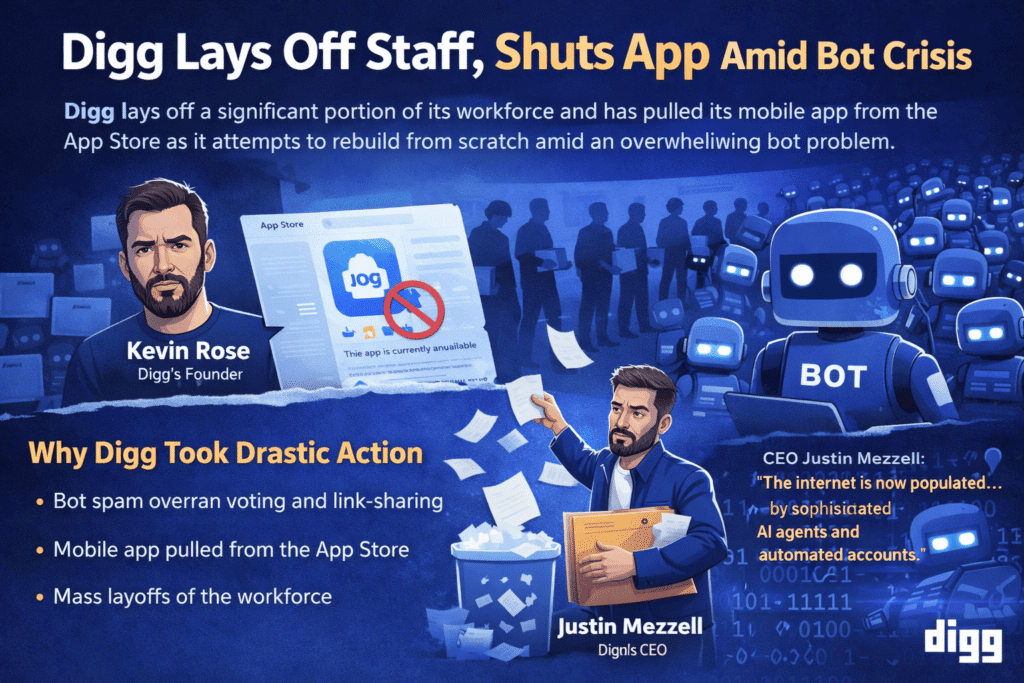
Digg lays off a significant portion of its workforce and has pulled its mobile app from the App Store as the Kevin Rose-led company attempts to rebuild from scratch. CEO Justin Mezzell announced Friday that the startup isn’t closing, but the company is taking drastic action after struggling with an overwhelming bot problem that made the site’s core voting mechanism unreliable.
Why Digg Lays Off Staff and Pulls the Plug on Its App
Here’s the situation: Digg relaunched last year with a simple promise—create a community-driven link-sharing platform where users have real control and ownership. Kevin Rose, who founded the original Digg before it collapsed a decade ago, returned as the company’s full-time focus after acquiring what remained of the old site alongside Reddit co-founder Alexis Ohanian.
But things fell apart quickly. When Digg’s beta launched, the company discovered it was immediately flooded by SEO spammers exploiting the site’s Google link authority. Within hours, sophisticated AI agents and automated accounts descended on the platform. Mezzell described it bluntly: “The internet is now populated, in meaningful part, by sophisticated AI agents and automated accounts.”
(See also: Claude Ai Memory Feature Free Users Import Tools)
The company tried everything. It banned tens of thousands of accounts, deployed internal tools, and worked with external vendors. None of it stuck. For a platform that depends on user votes to rank content—Digg’s entire business model—uncontrollable bot activity meant those votes couldn’t be trusted. What’s the point of community curation if bots are doing most of the voting?
A Broader Internet Problem That Goes Beyond Digg
But here’s the thing: Digg’s bot problem isn’t unique. Mezzell acknowledged what tech observers have been discussing for years—the “dead internet theory,” which claims today’s web is populated more by bots than actual people. “This isn’t just a Digg problem. It’s an internet problem,” he wrote in the company’s official post announcing the layoffs.
Read more: Mandiant Founder 190 Million Ai Security Startup.
That candid assessment reveals something important about the state of online communities in 2024. Even well-funded startups with experienced founders can’t outrun the tide of automated spam and fake accounts. The Digg reboot also faced another mountain: direct competition with Reddit, an entrenched platform with millions of users and years of community investment. Mezzell didn’t mince words, calling competing against Reddit not just a “moat” but a “wall.”
So Digg is hitting reset. Rose, who previously split time as an advisor at venture firm True Ventures, will now make Digg his primary focus. The company didn’t disclose how many employees were laid off, but confirmed that a small core team will continue rebuilding Digg into something “genuinely different.” The Digg app has vanished from the App Store, and the company’s website currently features only Mezzell’s layoff announcement. The one thing continuing: Diggnation, the podcast Rose hosts, will stay alive.
What This Means for the Future of Link-Sharing Communities
The Digg shutdown illustrates a harsh reality for startups trying to build social platforms today. The infrastructure that made early internet communities work—trust in user identity, faith in organic voting, genuine human participation—has eroded. Building something new requires solving problems that didn’t exist ten years ago.
The company’s layoffs represent a strategic pivot, not a death spiral. Rose and Ohanian acquired the Digg assets through a leveraged buyout involving True Ventures, Ohanian’s firm Seven Seven Six, and the venture firm S32. They had the resources and the credibility to make this work. The fact that they’re pulling back instead of doubling down suggests the challenge is bigger than money or effort alone.
What comes next remains unclear. Mezzell promised Digg would return as something “genuinely different,” but didn’t specify what that looks like. Whether the company can actually solve the bot problem, compete with Reddit, and rebuild user trust from scratch is an open question. For now, Digg is in hibernation—waiting for Kevin Rose to figure out how to build a functioning community in an internet that’s increasingly populated by machines.
Key Takeaways
- Digg lays off staff and pulled its mobile app after launching only months ago, with CEO Justin Mezzell citing overwhelming bot spam and AI-driven attacks as the primary reason the platform became unusable.
- The company’s struggles with automated accounts and SEO spammers validate the “dead internet theory”—the notion that modern web traffic is dominated by bots rather than real people—a problem that extends far beyond Digg alone.
- Kevin Rose is returning full-time to lead the rebuild, but the company faces a steep climb competing against entrenched rivals like Reddit while simultaneously solving a fundamental problem affecting the entire internet ecosystem.