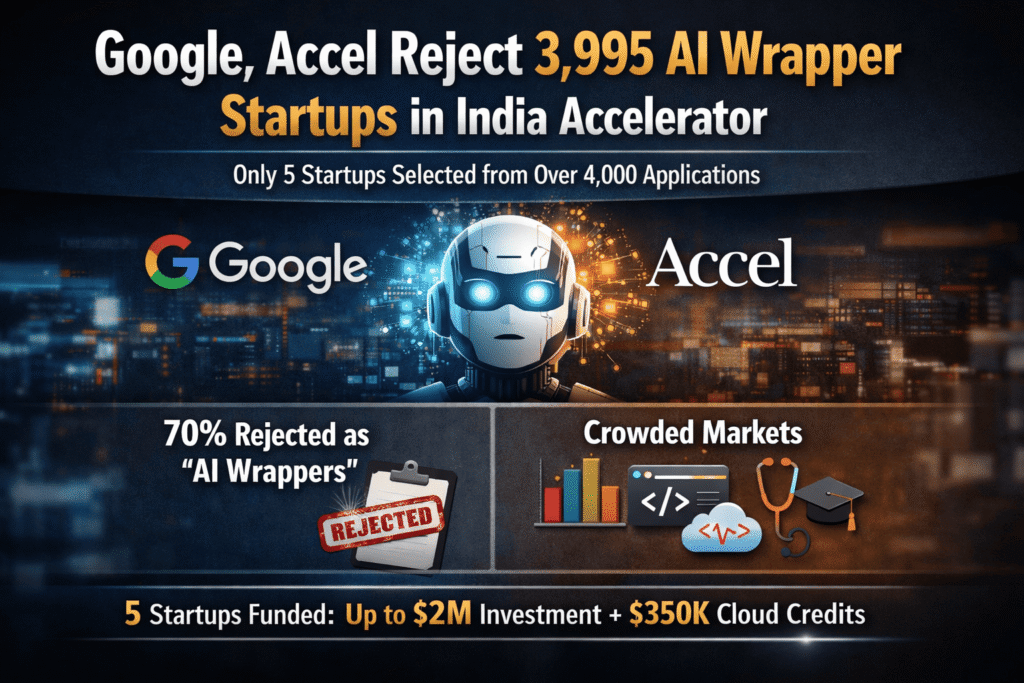
When Google and venture capital firm Accel reviewed over 4,000 applications for their joint AI accelerator in India, they faced a familiar problem: too many AI wrapper startups with little real innovation. But here’s what sets apart the five companies they actually chose to fund.
Ai Wrapper Startups: The wrapper problem is real—and pervasive
About 70% of rejected applications were what insiders call “wrappers”—startups that simply bolt AI chatbots or other features onto existing software without fundamentally rethinking how work gets done. That’s not a knock on the founders. It’s a reality check on how commoditized basic AI tools have become.
“Wrapper” ideas dominated because they’re easy to build. You take ChatGPT or another large language model, add a simple interface, and suddenly you’ve got something that looks innovative. But here’s the thing: when the companies that actually built those underlying AI models keep adding features, wrapper startups become instantly obsolete.
Accel partner Prayank Swaroop was blunt about what he saw in the rejected batch. “They were not reimagining new workflows using AI,” he told TechCrunch. That distinction matters. There’s a huge difference between layering AI onto an old process and designing entirely new ways of working that actually need AI to function.
What killed most applications—beyond being AI wrappers
The wrapper problem wasn’t the only reason applications got rejected. Another chunk landed in what investors call “crowded categories,” places where dozens of startups are chasing the same market with minimal differentiation. Marketing automation tools. AI recruitment platforms. You’ve probably seen ten pitches for these exact ideas.
Around 75% of all submissions fell into two narrow buckets: productivity tools (62%) and software development or coding assistance (13%). That’s a massive red flag for investors. When three-quarters of your applicant pool is building nearly identical enterprise software, you know something’s off with the ecosystem.
Swaroop had actually hoped to see more ambitious ideas in healthcare and education—sectors where AI could genuinely solve hard problems. Instead, India’s AI startup scene is fixated on the safe, obvious plays. The program received nearly four times more applications than previous Atoms cohorts, likely attracting first-time founders who didn’t have experience distinguishing their ideas from the crowd. (See also: Google Cloud Ai Model Capability Frontiers)
What Google and Accel are actually looking for
So what did the five chosen startups do right? According to Jonathan Silber, co-founder and director of Google’s AI Futures Fund, they’re aligned with areas where AI will see genuine real-world adoption—not just theoretical potential.
Here’s a crucial detail: the program doesn’t require startups to use only Google’s AI models. Many of them mix and match, combining different models depending on what specific workflow they’re solving for. That flexibility matters because it forces Google to stay sharp. “If a company is using an alternative model, that means Google has work to do to build the best model in the market,” Silber said.
There’s actually a smart strategy buried in this approach. Google gets feedback from these startups about how its models perform in real-world conditions. That data flows back to Google DeepMind’s teams, which use it to improve future models. It’s what Silber calls a “flywheel” between startup experimentation and AI development—the startups get funding and infrastructure, Google gets practical intelligence about what works and what doesn’t.
The five startups selected for this cohort will each receive up to $2 million from Accel and Google’s AI Futures Fund, plus up to $350,000 in cloud and compute credits from Google. It’s a meaningful investment, but it’s selective. Out of 4,000 applications, only five made the cut. That’s a 0.125% acceptance rate.
Key Takeaways
- AI wrapper startups—those that simply layer AI features onto existing software without reinventing workflows—dominated 70% of rejected applications, showing how saturated the market is with shallow AI ideas.
- India’s AI startup ecosystem is heavily concentrated on enterprise productivity tools and coding assistance, with three-quarters of applications falling into these crowded categories where differentiation is nearly impossible.
- Google and Accel’s five selected startups focus on areas with genuine real-world adoption potential, and they deliberately don’t restrict startups to using only Google’s models, creating a feedback loop that helps Google improve its AI products.