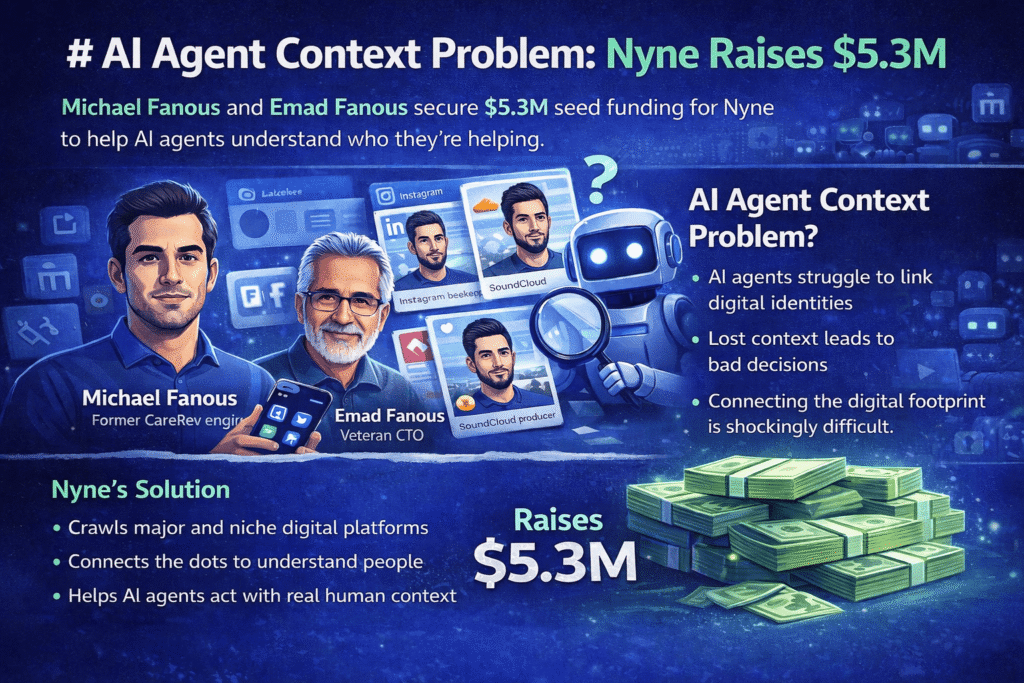
Autonomous AI agents are coming for your calendar and your wallet—but they’re missing something crucial. The AI agent context problem is becoming clearer as Michael Fanous, a former machine learning engineer at CareRev, and his father Emad Fanous just raised $5.3 million to tackle it. Their startup, Nyne, wants to become the intelligence layer that helps AI agents actually understand the people they’re supposed to serve.
The AI Agent Context Problem Nobody’s Talking About
Here’s the thing: AI agents today are about to start making purchasing decisions, scheduling appointments, and managing your digital life. But they’re flying blind.
Michael Fanous says these agents can’t do something that seems obvious—figure out that your LinkedIn profile, your Instagram account, and your public government records all belong to the same person. Sound familiar? It’s a version of the same problem identity verification services have solved. But for AI agents working across the open internet, it’s apparently “an oddly hard problem to solve,” according to Nichole Wischoff, founder of Wischoff Ventures, which led Nyne’s seed round.
Google solved this years ago with search history and cross-platform data. But Google isn’t sharing that secret sauce with anyone else. So for the rest of the AI ecosystem, identifying and understanding a single human across their digital footprint remains shockingly difficult. Nyne just got $5.3 million to fix it, with backing from Wischoff Ventures and South Park Commons, plus angel investors including Gil Elbaz, co-founder of Applied Semantics and the architect behind Google AdSense.
How Nyne Solves the AI Agent Context Problem
The solution sounds deceptively simple: deploy millions of agents across the internet to analyze public digital activity, then apply machine learning to connect the dots. Nyne’s approach triangulates information about a person by looking across Instagram, Facebook, X, but also niche platforms like SoundCloud and Strava. (See also: Mandiant Founder 190 Million Ai Security Startup)
“Once you make all these connections, you can understand a person fairly deeply—their interests, their hobbies, and how they think about very specific things,” Fanous told TechCrunch. He added that once Nyne builds that profile, he can “give them any piece of information about a person that could be useful to make the right next action.”
Wischoff was blunt about the commercial potential. “How do I know you’re pregnant and sell you A, B, or C as early as possible?” she asked. Previous adtech companies gathered some of this data, but Nyne intends to do it with much more precision—and specifically for a world where AI agents are the ones making the moves, not humans clicking ads.
Why This Matters for AI Agents and Marketers
The market for this kind of intelligence is massive. As more companies deploy AI agents to reach customers, they’ll need something like Nyne to give those agents real-world context. Without it, an AI agent trying to sell you something doesn’t actually know who you are.
But here’s what you need to know: this isn’t just about advertising. As AI agents start handling your schedule, your purchasing decisions, and potentially your finances, they need to understand your actual preferences, your budget, your lifestyle. That requires connecting the dots across your entire digital footprint—something Nyne is now positioned to do at scale.
Fanous says the father-son partnership works because he brings the technical vision while his veteran CTO dad brings operational experience. For now, Nyne is focused on building that identity layer. The real test comes when the first wave of consumer-facing AI agents actually starts using it—and when regulators start asking hard questions about how much of your digital life can be analyzed and connected without your explicit consent.
Key Takeaways
- Nyne just raised $5.3M to solve the AI agent context problem—helping autonomous agents identify and understand humans across their fragmented digital footprint.
- The startup deploys millions of internet-crawling agents to connect information across major social networks and niche platforms like Strava and SoundCloud, building detailed profiles of individuals.
- This intelligence layer is becoming critical as AI agents move from experimental to production, preparing to make autonomous decisions about purchases, scheduling, and customer outreach for businesses.