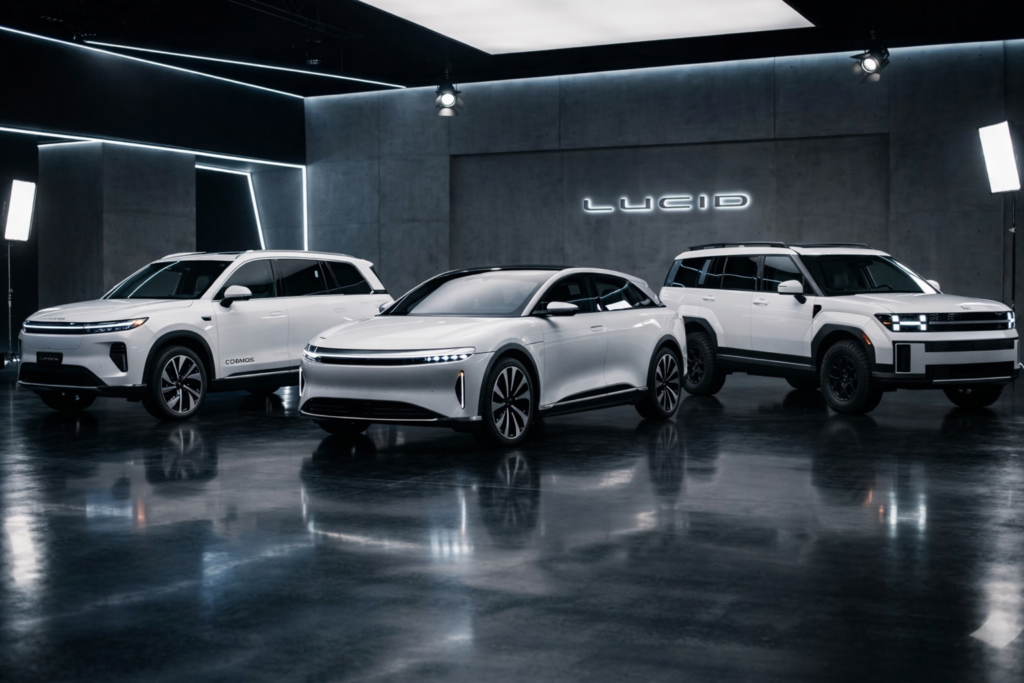
Lucid mid-size SUVs — Lucid is making a bold bet on the mass market. At an investor event in New York on Wednesday, the California electric vehicle startup confirmed plans to build at least three new mid-size SUVs based on a fresh platform, undercutting Tesla and traditional automakers with a sub-$50,000 price target. The announcement also included a surprise: a two-seater robotaxi concept called the Lunar, which signals Lucid’s growing ambitions beyond luxury sedans and high-end performance vehicles.
Lucid Mid-Size Suvs: Lucid’s Three Mid-Size Models: Earth, Cosmos, and
The first two vehicles have names now. The Earth will arrive as a smaller, more streamlined version of Lucid’s Gravity SUV, while the Cosmos targets buyers who want what Lucid describes as “exceptional efficiency, space, and performance.” Based on teaser images shown at the event, the Cosmos features a lower, sloping roofline that gives it a sleeker profile than the Earth.
Then there’s the third model, still unnamed. This one’s different—it’s built for off-roading. The concept images show a more upright, squared-off design with a higher ground clearance, suggesting Lucid sees an opportunity in the adventure-ready segment that’s booming right now. All three vehicles will share the same underlying architecture, which Lucid calls its mid-size platform.
Here’s the kicker: Lucid’s targeting a starting price below $50,000 for these vehicles. That’s a significant shift for a company that built its reputation on ultra-luxury cars. It’s also a direct shot at Tesla’s Model Y and upcoming Chinese competitors that’ve been eating Lucid’s lunch in the affordable EV space.
Read more: Autonomous Vehicle Technology Nuro Autonomous.
The New Atlas Drive Unit Changes the Game
What makes these three SUVs possible is something Lucid calls the Atlas drive unit. It’s smaller, lighter, and simpler than the powertrains currently in the Lucidity Air and Gravity models. The key innovation? Identical front and rear housings with standardized mounts that’ll slash manufacturing costs—a crucial detail when you’re trying to hit $50,000.
Why does this matter? Because electric vehicles are still expensive to build, and Lucid’s been hemorrhaging money trying to scale production. The Atlas unit represents the company’s best shot at actually reaching profitability. If Lucid can nail the manufacturing efficiency here, it won’t just help the Earth and Cosmos—it could become the foundation for everything the company builds going forward.
The mid-size platform will also use this new drive unit, giving Lucid a chance to prove it can compete on cost without sacrificing the performance and efficiency claims that built the brand.
Read more: Upcoming Electric Vehicles Coming Soon.
The Lunar Robotaxi Joins Lucid’s Autonomous Push
Don’t expect to hail a Lucid robotaxi tomorrow. The Lunar is still a concept, and the images make that crystal clear—there are no doors, no steering wheel, and no pedals. It’s a two-seater purpose-built for autonomous operation, and it’s obviously years away from hitting streets.
But here’s what it signals: Lucid’s serious about the autonomous vehicle market. The company’s already working with Uber and Nuro on a robotaxi service using Gravity-based vehicles, and that partnership’s expanding. The new agreement with Uber will deploy mid-size vehicles “at a scale similar to the Gravity robotaxi program,” which means Lucid’s betting big on self-driving becoming a real business line.
The Lunar’s design appears to be Lucid’s answer to Tesla’s Cybercab robotaxi, which Tesla unveiled last year. While Tesla’s betting on retrofitting existing vehicles, Lucid’s building something from the ground up. Whether that approach pays off depends entirely on whether autonomous technology actually works at scale—something that remains very much an open question in the industry.
What’s at Stake for Lucid
Let’s be direct: Lucid’s under serious pressure. The company burned through cash to launch the Gravity last year, and it’s still not profitable. Expanding into mass-market vehicles with these three mid-size SUVs is risky, but it’s also the only way the company survives. You can’t run a car company on luxury sales alone—ask Lamborghini.
The sub-$50,000 price point is ambitious. Lucid will need to sell these vehicles in serious volume to make the economics work. The partnership with Uber on robotaxis adds another revenue stream, but again, that’s years away from generating meaningful income.
The bottom line is this: Lucid’s betting everything on execution. The mid-size platform launch, the Atlas drive unit’s manufacturing efficiency, and the company’s ability to scale production—all of it has to work. If it does, Lucid becomes a real competitor to Tesla and legacy automakers. If it doesn’t, we’re looking at another cautionary tale in the EV industry.
Key Takeaways
- Lucid confirmed three new mid-size SUVs—the Earth, Cosmos, and an unnamed off-road model—all targeting a sub-$50,000 price point, a major shift toward the mass market for the luxury EV brand.
- The new Atlas drive unit is smaller, lighter, and cheaper to manufacture than Lucid’s existing powertrains, making the affordability goals realistic and potentially transforming the company’s future product lineup.
- Lucid’s expanding its Uber robotaxi partnership to include mid-size vehicles at scale, signaling serious ambitions in autonomous vehicles while the concept Lunar robotaxi remains years away from production reality.