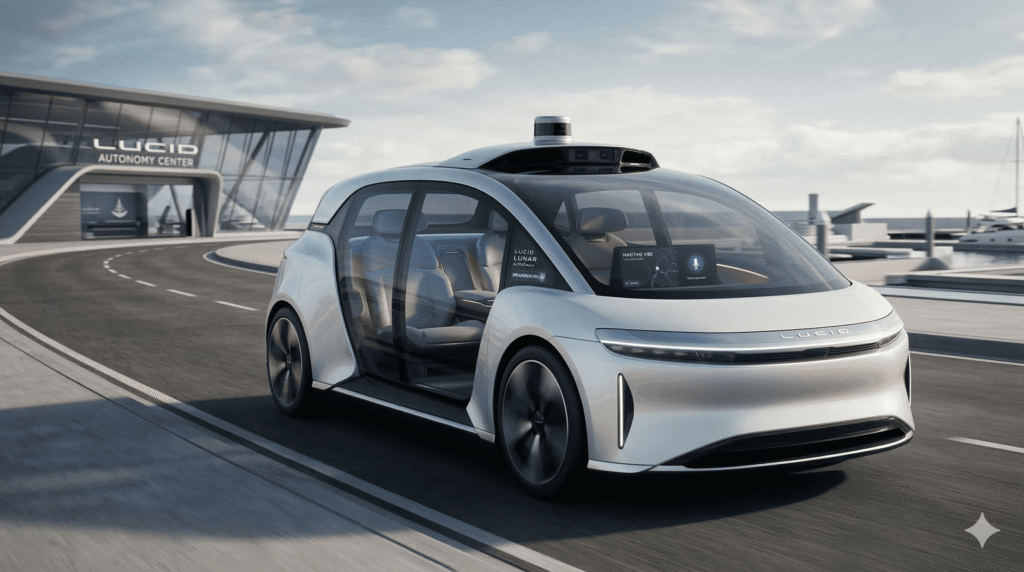
Lucid Motors robotaxi — Lucid Motors is making a serious bet on robotaxis. The electric vehicle maker debuted its “Lucid Lunar” concept—a two-seater autonomous vehicle with no steering wheel or pedals—at an investor day in New York on Thursday, signaling that the company wants to build a profitable autonomy business alongside its core EV operations.
Lucid Motors Robotaxi: The Lunar Concept and Uber Partnership
Here’s what Lucid showed off: a sleek robotaxi designed on the same platform as the company’s upcoming mid-size electric vehicles. It’s a clean concept, but there’s a catch—the company admitted to TechCrunch that there’s actually no active development happening on the Lunar yet. Think of it as a vision statement for now.
Read more: Autonomous Vehicle Technology Nuro Autonomous.
But the real news is Lucid’s partnership track record. The company is close to an agreement with Uber to collaborate on a robotaxi built from one of its mid-size vehicles. More immediately, Lucid is already working with autonomous vehicle company Nuro on an autonomous version of the Gravity SUV that’ll launch on Uber’s network by the end of this year in the San Francisco area. Whether that vehicle uses Nuro’s self-driving tech remains unclear—neither company confirmed it.
Autonomy Subscriptions: Where the Real Money Is
So what does Lucid actually have ready to sell? Subscription software. The company plans to launch monthly subscriptions for its DreamDrive Pro starting in the first half of 2027, with pricing that scales based on capability. At the bottom tier, you’re looking at $69 a month for basic driver assistance. Go all the way to the top, and that’s $199 monthly for full self-driving capability where you never have to take over—though Lucid hasn’t actually built that feature yet.
This strategy isn’t new. Tesla’s been monetizing autonomy through subscriptions for years with its Full Self-Driving (Supervised) offering, and Rivian announced a similar approach at its own autonomy event in December. But here’s the thing: Lucid’s internal projections show that autonomy subscriptions could become “the single biggest software monetization opportunity” for the company. The company even displayed a bar chart during the event showing robotaxi partnership revenue dwarfing EV licensing revenue—though notably, there was no label on the Y-axis, which raises some questions about how concrete those numbers really are.
AI Assistant and the Road Ahead
Like Rivian, Lucid is also developing an in-cabin AI assistant. The company is aiming to handle everything from simple commands—like adjusting the air conditioning—to more complex requests like finding “something unique, maybe off the beaten path with a maritime vibe.” Sounds nice in theory. In practice? The company’s live demo of the assistant failed during the event, so they showed a pre-recorded video instead. That’s not exactly confidence-inspiring.
What Lucid’s investor day really revealed is a company desperate to diversify its revenue streams. EV sales alone aren’t cutting it financially. Robotaxi partnerships, subscription software, and AI services are now central to the company’s strategy. The question is execution. Lucid has a track record of announcing bold plans and then facing delays and technical hurdles. Whether the company can actually deliver on these autonomy promises—and turn them into real revenue—remains wide open.
Key Takeaways
- Lucid Motors debuted the ‘Lunar’ robotaxi concept at an investor day, but admitted there’s no active development yet. The vehicle is designed to launch after the company’s mid-size EV line.
- The company is pursuing multiple autonomy revenue streams: a partnership with Uber for robotaxis, monthly DreamDrive Pro subscriptions starting at $69/month, and an in-cabin AI assistant.
- Lucid’s internal projections show robotaxi partnerships could become the biggest software revenue opportunity, but the company faces the same skepticism it’s encountered with previous autonomous driving claims.